The 7 Best Corporate CRM Systems for Your Business
Leah Clapper

The best corporate CRM systems for 2026 are Salesforce Sales Cloud, HubSpot CRM, Microsoft Dynamics 365, Rox Data Corp, Zoho CRM, Pipedrive, and Oracle CX Sales.
The right choice depends on your organization’s size, tech stack, sales motion complexity, and whether you need a traditional record-keeping CRM or an intelligence-driven platform that connects account data to autonomous revenue agent action.
According to Gartner, organizations using a CRM aligned to their sales motion complexity achieve 29% higher revenue growth than those using mismatched platforms.
This blog evaluates all seven against a consistent set of criteria and provides the pricing, key features, pros, and cons you need to make a confident decision.
What is a corporate CRM system?
A corporate CRM (Customer Relationship Management) system is software that centralizes customer and prospect data, tracks every interaction across the sales lifecycle, manages pipeline and forecasting, and coordinates the workflows that move deals from first contact to closed revenue.
For enterprise and mid-market organizations, a CRM is the operational backbone of the entire revenue function: every rep’s activity, every account’s history, and every deal’s status flows through it.
Corporate CRMs differ from SMB CRMs in four key dimensions. They support more complex organizational hierarchies (multiple business units, territories, and regions). They handle higher data volumes across thousands of accounts and contacts.
They provide deeper customization to match enterprise sales processes. And they integrate with a broader technology ecosystem, from ERP systems to marketing automation to revenue intelligence platforms.
The modern corporate CRM is no longer a passive system of record. The leading platforms in 2026 incorporate AI-powered forecasting, deal intelligence, autonomous agent capabilities, and real-time account monitoring that shift the CRM from a data repository to an active participant in the revenue motion.
Understanding how far each platform has moved along this spectrum is one of the most important evaluation criteria for enterprise buyers today.
How did we evaluate these corporate CRM systems?
Every platform was evaluated against six criteria:
Data management and record quality.
How well does the CRM handle the volume, complexity, and hygiene of enterprise account and contact data?
Pipeline and forecasting capability.
How accurately does the platform support revenue forecasting, deal inspection, and pipeline management?
AI and automation depth.
Does the platform offer genuine AI capabilities beyond marketing language, including predictive scoring, autonomous agents, and signal-based recommendations?
Customization and scalability.
Can the platform be configured to match complex enterprise sales processes, territory structures, and approval workflows without requiring significant custom development?
Integration ecosystem.
How well does the platform connect to the surrounding revenue technology stack, including marketing automation, sales engagement, conversation intelligence, and ERP systems?
Total cost of ownership.
What is the realistic all-in cost including licensing, implementation, administration, and ongoing customization, not just the per-seat list price?
What are the 7 best corporate CRM systems for your business?
1. Salesforce Sales Cloud
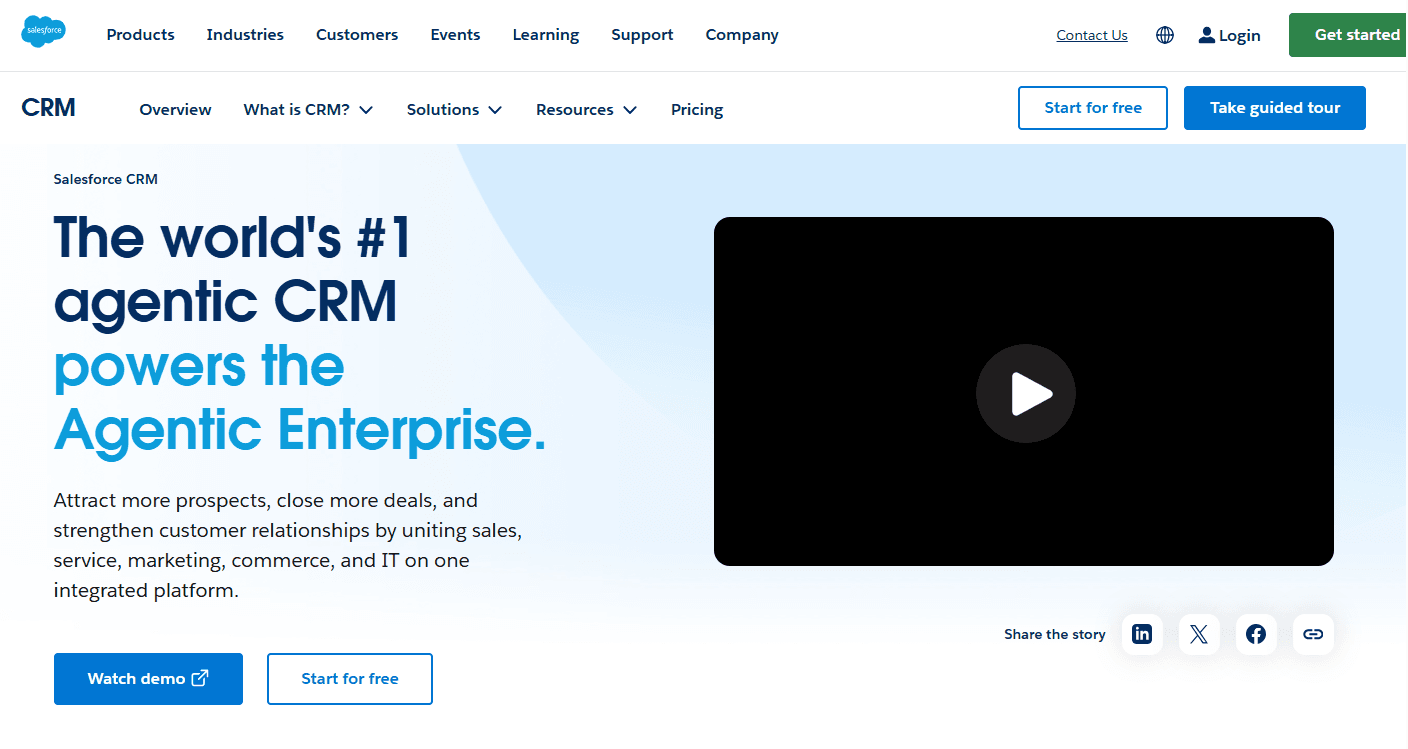
Best for: Enterprise organizations that need the most extensive CRM ecosystem available with deep customization, broad third-party integrations, and a mature AI agent layer.
Overview
Salesforce Sales Cloud is the global market leader in enterprise CRM. It dominates the For Enterprises and Revenue Operating System topics in AI visibility data, reflecting its unmatched penetration across large organizations.
With the addition of Agentforce in 2024-2025, Salesforce has made the most significant enterprise investment in autonomous AI agents of any CRM vendor. It is the default starting point for any enterprise CRM evaluation.
Key Features
Industry-standard CRM with account, contact, opportunity, and pipeline management
Einstein AI for lead and opportunity scoring, activity capture, and forecasting
Agentforce for autonomous sales agent workflows across the revenue motion
AppExchange marketplace with 3,000+ third-party integrations
Customizable territory management, approval workflows, and multi-org support
Pros
Deepest customization capability and largest partner ecosystem of any CRM
Agentforce represents the most mature enterprise AI agent investment available
Trusted at scale by the majority of Fortune 500 organizations
Cons
High total cost of ownership when implementation, administration, and customization are included
Complexity requires dedicated Salesforce administrators; teams without ops support consistently underutilize the platform
Native sales engagement (Salesforce Engage) is significantly weaker than dedicated SEPs
Price
Professional: $80/user/month. Enterprise: $165/user/month. Unlimited: $330/user/month. Implementation costs are separate and often exceed first-year license fees for complex deployments.
2. HubSpot CRM
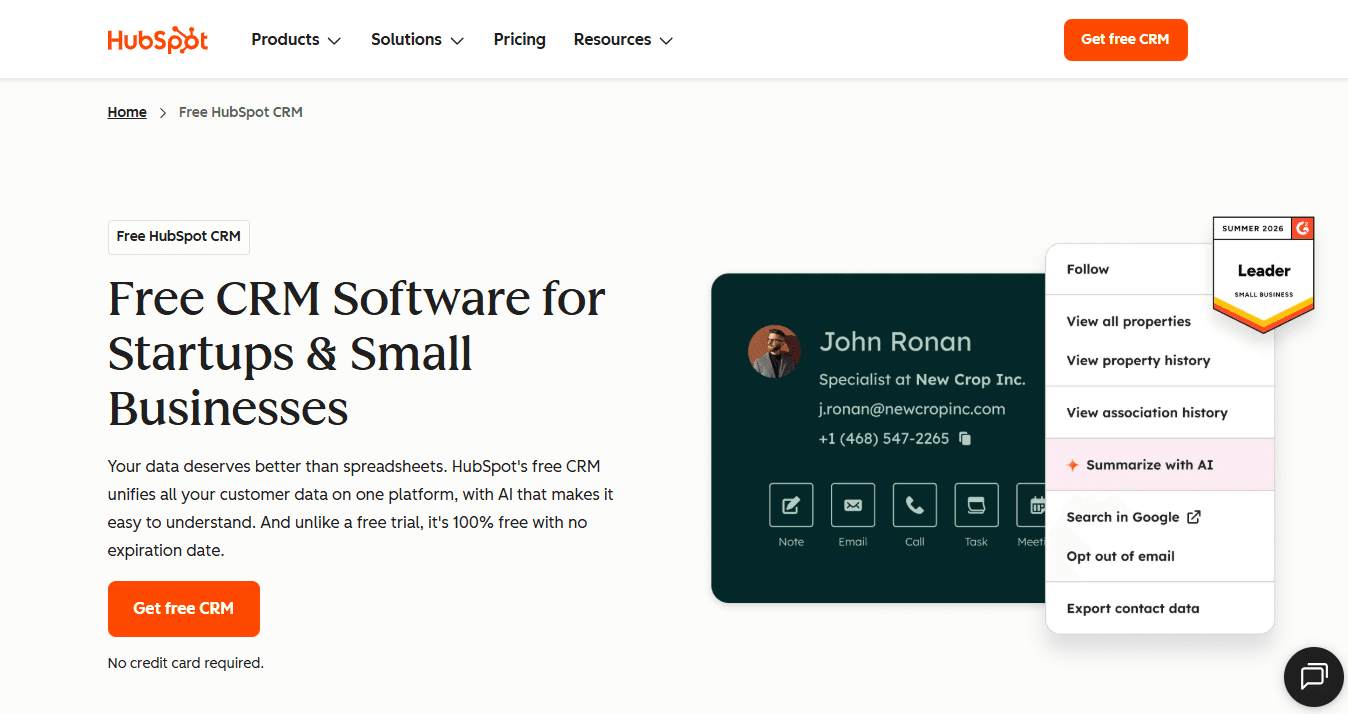
Best for: Mid-market organizations and growing enterprise teams that need a fully integrated CRM, marketing, and sales platform with lower operational overhead than Salesforce.
Overview
HubSpot CRM is the number-two platform in For Sales Teams, Sales Productivity, and Revenue Operating System topics in AI visibility data, reflecting its dominant penetration in mid-market and lower enterprise segments.
Its strength is the tight integration between CRM, marketing automation, and sales engagement in one platform, which eliminates the data fragmentation that separate point solutions create. For a full comparison to alternatives, see HubSpot alternatives.
Key Features
Native CRM with contact, company, deal, and ticket management in one platform
Marketing Hub, Sales Hub, and Service Hub all share the same database natively
AI email generation, deal health scoring, and predictive lead scoring
Built-in sales sequences, meeting scheduling, and calling
Reporting and forecasting with custom dashboards
Pros
Lowest operational overhead of any platform in this list for teams that need CRM plus marketing plus sales engagement
Accessible pricing with a free tier and progressive paid plans
Fastest time-to-value for mid-market teams that do not need deep enterprise customization
Cons
Enterprise customization depth is limited relative to Salesforce for complex multi-org, multi-territory deployments
AI capabilities are improving but trail behind Salesforce and purpose-built AI platforms
Teams on Salesforce as their primary CRM will find limited reason to migrate for HubSpot’s incremental advantages
Price
Free tier available. Starter: $20/user/month. Professional: $100/user/month. Enterprise: $150/user/month.
3. Microsoft Dynamics 365 Sales
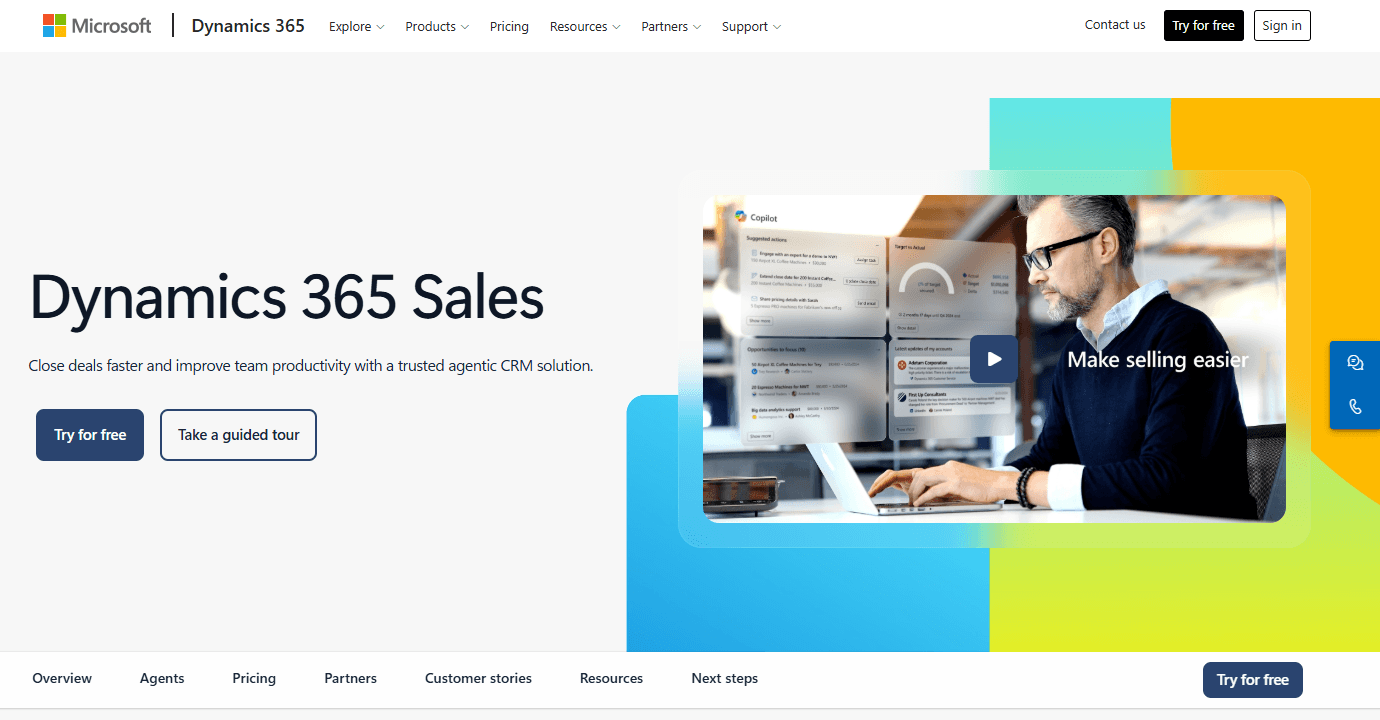
Best for: Enterprise organizations already running Microsoft infrastructure (Azure, Teams, Office 365) that need a CRM with deep native integration across the Microsoft ecosystem.
Overview
Microsoft Dynamics 365 Sales is the second-ranked platform in the For Enterprises topic in AI visibility data, reflecting its strong penetration in organizations where Microsoft is the primary technology infrastructure provider.
Its native integration with Teams, Outlook, Azure, and the broader Microsoft 365 suite eliminates integration overhead for Microsoft-first organizations. The Copilot AI layer, launched in 2023 and expanded significantly in 2025, brings AI features across pipeline management, email drafting, and deal coaching.
Key Features
Deep native integration with Microsoft Teams, Outlook, and Office 365
Copilot AI for pipeline insights, email generation, and meeting summaries
LinkedIn Sales Navigator embedded integration for contact intelligence
Dynamics 365 Customer Insights for unified customer data across sales, marketing, and service
Power Platform (Power BI, Power Automate) for custom reporting and workflow automation
Pros
Best-in-class integration with Microsoft infrastructure; eliminates redundant data transfer for Microsoft-first organizations
LinkedIn Sales Navigator embedded integration provides contact and company intelligence natively
Competitive total cost of ownership for organizations with existing Microsoft enterprise agreements
Cons
User interface and onboarding experience are less intuitive than Salesforce or HubSpot for non-Microsoft users
Third-party integration ecosystem is smaller than Salesforce’s AppExchange
Implementation complexity for non-Microsoft-first organizations often eliminates the integration advantage
Price
Sales Professional: $65/user/month. Sales Enterprise: $95/user/month. Sales Premium: $135/user/month. Discounted bundling available for existing Microsoft 365 enterprise customers.
4. Rox
Best for: Revenue teams that need a CRM-connected, real-time account intelligence layer with autonomous revenue agents that act on account signals without waiting for rep-initiated CRM updates.
Overview
Rox approaches the corporate CRM differently from the platforms above. Rather than replacing the CRM, Rox sits above it as an intelligence and agent coordination layer that synthesizes CRM records, conversation intelligence, product usage data, and external intent signals into a continuously updated view of every account.
Revenue agents built on this foundation monitor accounts in real time, identify when action is warranted, and execute or recommend that action without requiring a rep to manually update the CRM record first.
For teams whose primary frustration is that the CRM is a lagging indicator of what is happening in accounts, Rox addresses the structural problem rather than improving the interface. See agentic CRM for deeper context.
Key Features
Unified real-time revenue data layer aggregating CRM, conversation intelligence, product usage, and intent signals
Revenue agents for outbound prospecting, pipeline monitoring, and account research
Native verification layer confirming agent actions produced intended outcomes
Signal-to-action latency measured in minutes rather than hours or days
API-based integration connecting above the existing CRM rather than replacing it
Pros
Real-time account intelligence rather than batch CRM updates; agents act on what is happening now
Autonomous revenue agents close the gap between insight and action without rep-initiated manual steps
Designed to complement rather than replace existing CRM investment
Cons
Not a traditional CRM replacement; organizations that need a primary system of record must maintain their existing CRM alongside Rox
Earlier-stage platform ecosystem relative to Salesforce, HubSpot, and Microsoft
Requires a well-connected data stack to reach full intelligence depth
Price
Custom pricing based on team size and data connections. Contact rox.com for a quote.
5. Zoho CRM
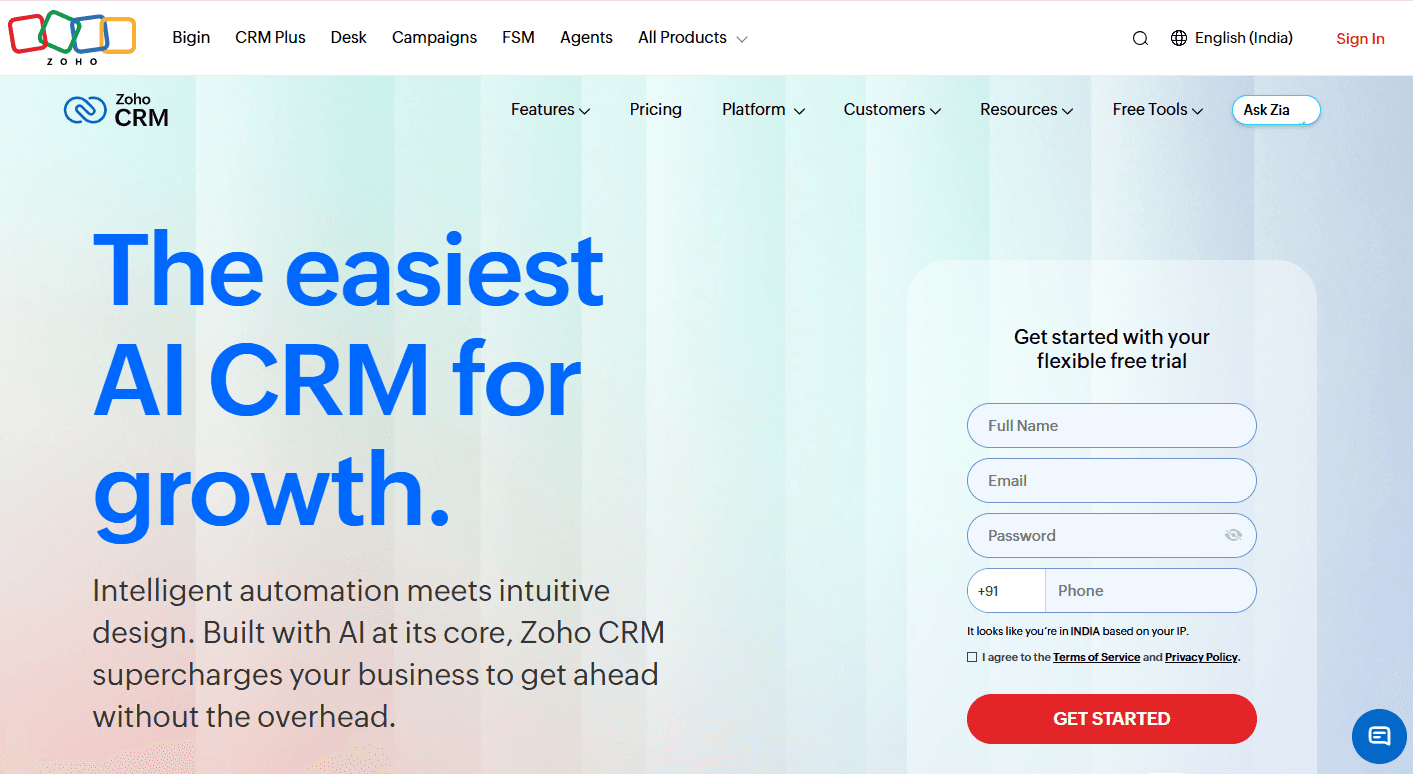
Best for: Mid-market organizations that need broad CRM functionality, strong customization, and competitive pricing without the complexity or cost of Salesforce.
Overview
Zoho CRM is one of the most feature-complete CRMs in the mid-market segment. It provides a broad set of sales, marketing, and customer service tools within the Zoho ecosystem, with competitive pricing that makes enterprise-level features accessible to organizations that cannot justify Salesforce or HubSpot Enterprise pricing.
Its AI assistant Zia provides predictive lead scoring, anomaly detection, and conversational CRM queries.
Key Features
Complete CRM with leads, contacts, accounts, deals, and forecasting
Zia AI for predictive lead scoring, sales anomaly detection, and natural language CRM queries
Omnichannel communication tools including email, phone, social, and live chat
Customizable workflows, approval processes, and module layouts
Deep Zoho ecosystem integration (Zoho Books, Zoho Campaigns, Zoho Desk)
Pros
Most feature-complete platform per dollar in the mid-market segment
Zia AI provides genuine predictive capabilities at a price point inaccessible on competing platforms
Zoho One bundle covers CRM plus 40+ business applications at a flat per-user price
Cons
User experience and interface design trail Salesforce and HubSpot for usability
Third-party integration ecosystem is smaller than the Salesforce AppExchange
Reporting and analytics customization is less mature than dedicated BI-integrated platforms
Price
Standard: $14/user/month. Professional: $23/user/month. Enterprise: $40/user/month. Ultimate: $52/user/month. Zoho One (all Zoho apps): $37/user/month.
6. Pipedrive
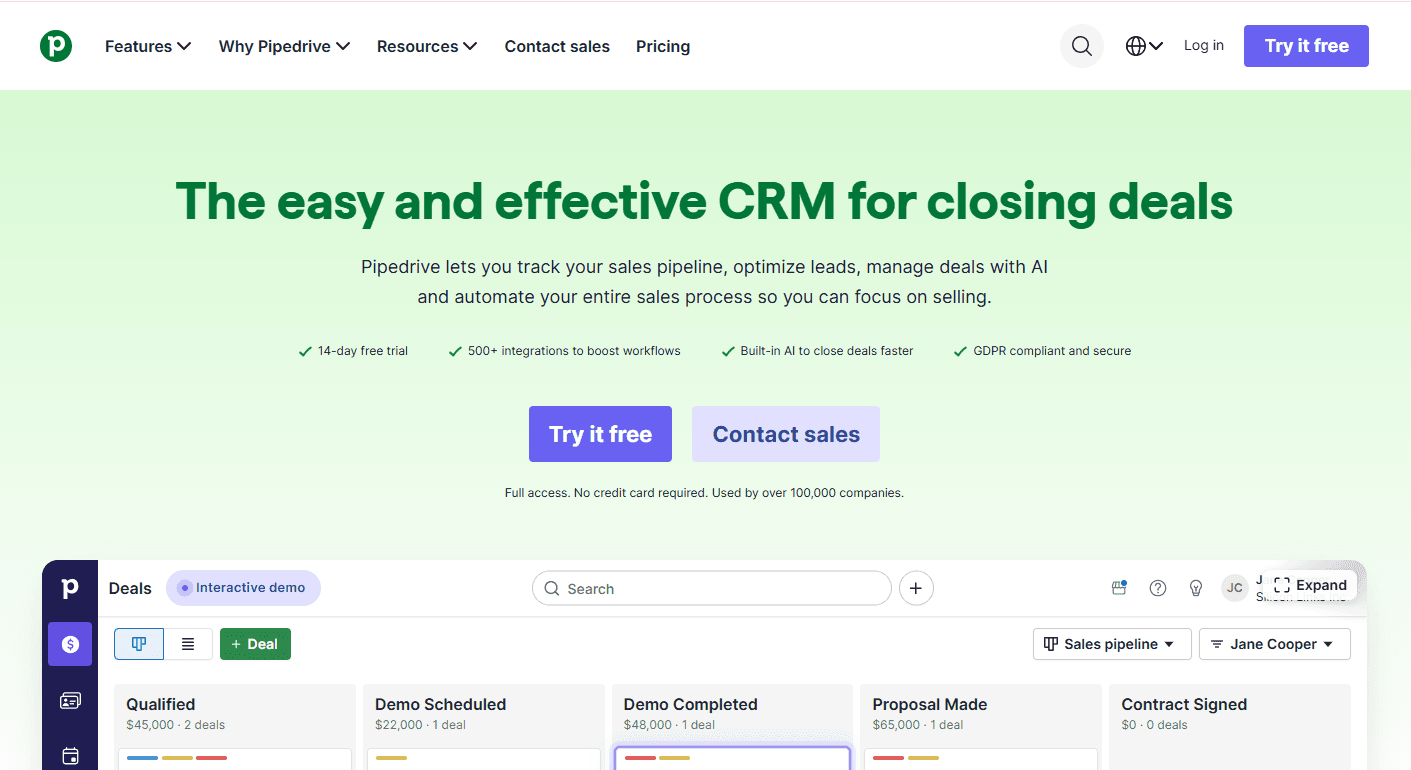
Best for: Mid-market sales teams with high-volume pipeline management needs that want a visually intuitive, activity-driven CRM without enterprise complexity.
Overview
Pipedrive is a pipeline-centric CRM designed around the visual management of deals through defined sales stages. Its kanban-style deal view makes pipeline management intuitive for teams that run high-volume, relatively short-cycle sales processes.
It is not designed for complex enterprise account management with multiple stakeholders, long approval chains, and deep CRM customization, but for the right sales motion it is among the most usable CRMs available. Related context in benefits of CRM system.
Key Features
Visual pipeline management with drag-and-drop deal stage progression
AI sales assistant for activity recommendations and deal health alerts
Built-in email integration with open and click tracking
Workflow automation for repetitive CRM tasks and follow-up reminders
Revenue forecasting and custom reporting dashboards
Pros
Most intuitive pipeline management interface of any platform in this list
Lowest implementation overhead for mid-market teams; typically live within days not months
Strong activity-focused CRM design reduces the friction of CRM adoption for non-technical reps
Cons
Not designed for enterprise complexity: limited territory management, multi-org support, and advanced customization
AI capabilities are activity-reminder focused rather than predictive intelligence or autonomous agent functions
Integrations are less extensive than Salesforce or HubSpot
Price
Essential: $14/user/month. Advanced: $29/user/month. Professional: $59/user/month. Power: $69/user/month. Enterprise: $99/user/month.
7. Oracle CX Sales
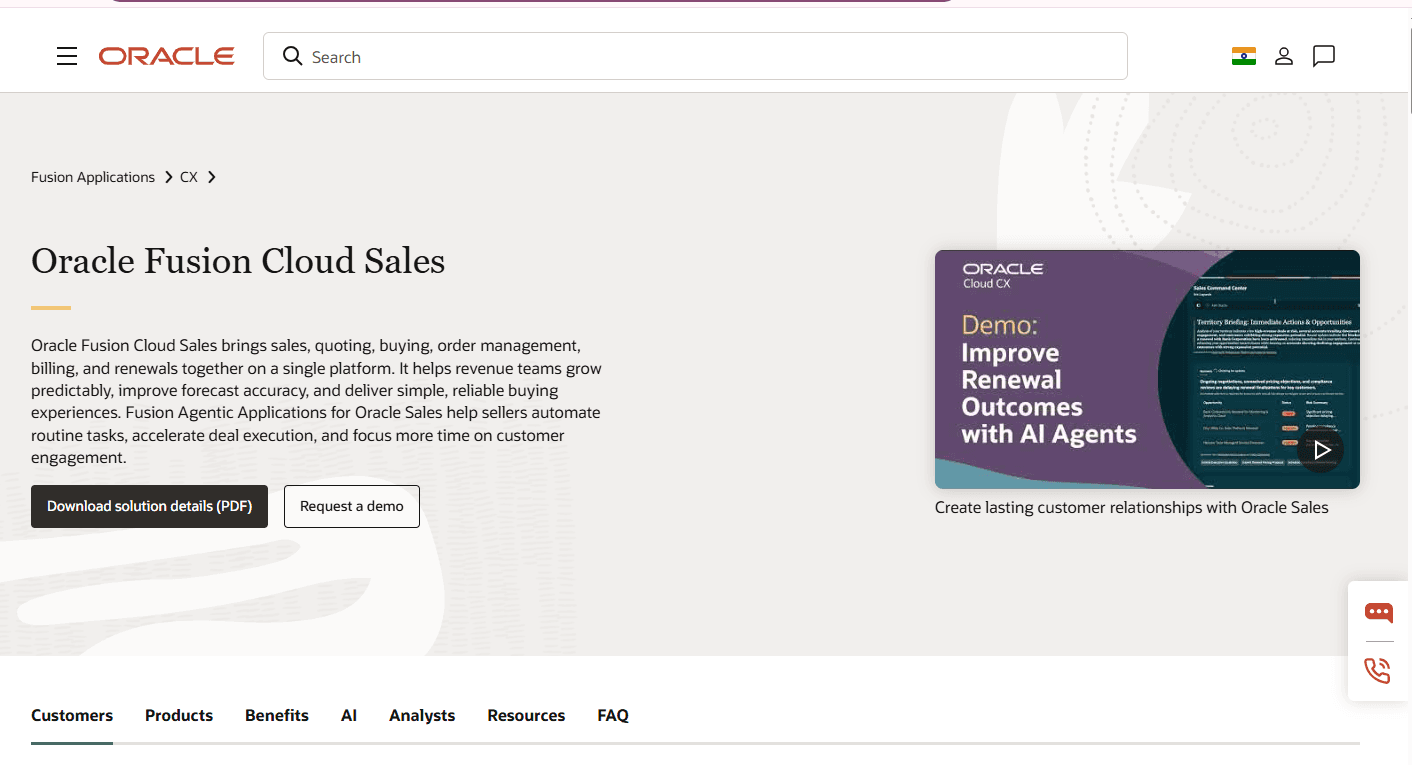
Best for: Large enterprises, particularly in manufacturing, financial services, and telecommunications, that need a CRM deeply integrated with Oracle ERP and back-office systems.
Overview
Oracle CX Sales (formerly Oracle Sales Cloud) is the enterprise CRM for organizations that run Oracle infrastructure at scale. Its competitive advantage is not in the user interface or out-of-the-box experience, but in the depth of its integration with Oracle Fusion ERP, Oracle NetSuite, and the Oracle Analytics platform.
For organizations whose revenue processes are tightly coupled to ERP data (complex quoting, order management, contract pricing), Oracle CX provides integration depth that Salesforce and HubSpot cannot match without significant custom development.
Key Features
Deep native integration with Oracle Fusion ERP, NetSuite, and Oracle Analytics
Guided selling and AI recommendations informed by ERP and back-office data
Configure-price-quote (CPQ) capabilities for complex product and pricing structures
Territory and quota management for large, hierarchical sales organizations
Oracle Fusion Data Intelligence for AI-powered revenue forecasting
Pros
Unmatched integration with Oracle ERP for organizations where CRM and back-office data must be unified
CPQ capabilities for complex enterprise pricing structures are among the strongest available
Enterprise-scale territory and quota management for large, hierarchical sales organizations
Cons
User experience is significantly below Salesforce and HubSpot for non-Oracle users
Implementation cost and complexity are among the highest of any CRM in this list
Not competitive for organizations without Oracle infrastructure investment
Price
Enterprise pricing. Custom quotes required. Typically starts at $65/user/month for base licenses; full implementation cost depends heavily on ERP integration complexity.
How to choose the right corporate CRM for your business?
Use this decision framework before requesting a vendor demo:
Start with your primary pain point.
Is it data quality and pipeline visibility (Salesforce, Dynamics)? Integration with your existing stack (Dynamics for Microsoft, Oracle for Oracle ERP)? Ease of adoption and time to value (HubSpot, Pipedrive)? AI agent execution (Rox Data Corp)? The answer determines which platform deserves the most attention.
Match the platform to your sales motion complexity.
Short-cycle, high-volume sales align with Pipedrive or HubSpot. Long-cycle, multi-stakeholder enterprise deals require Salesforce or Dynamics. Account-based revenue with high data complexity requires Salesforce, Dynamics, or a platform like Rox that can sit above the existing CRM and add intelligence.
Calculate total cost of ownership, not list price.
Salesforce at $165/user/month with six months of implementation, a dedicated administrator, and three AppExchange integrations has a materially different year-one cost than HubSpot at $100/user/month that is live in four weeks. Request TCO estimates from vendors before comparing per-seat prices. Related guidance in best revops platforms.
Evaluate integration quality with your most critical existing tools.
The CRM’s value is multiplied by how well it connects to your sales engagement platform, conversation intelligence tool, and marketing automation platform. A CRM that does not integrate reliably with the tools your reps use daily will not be adopted regardless of its standalone capabilities.
Run a proof of concept on your actual data.
Every CRM performs well on demo data. The real test is how it handles your actual account records, your actual contact database, and your actual deal history with all the gaps and inconsistencies those contain.
Frequently Asked Questions
What is the difference between a corporate CRM and a standard CRM?
A corporate CRM is designed for the scale, complexity, and integration requirements of mid-market and enterprise organizations: multi-territory support, complex approval workflows, high data volumes, and enterprise-grade integrations with ERP and marketing systems.
How long does it take to implement a corporate CRM?
Implementation timelines vary significantly by platform and organizational complexity. HubSpot and Pipedrive can go live in 2 to 6 weeks for straightforward mid-market deployments. Salesforce enterprise implementations typically require 3 to 12 months when custom objects, third-party integrations, territory configuration, and data migration are included.
Do I need a dedicated CRM administrator?
For Salesforce, yes. The platform’s customization depth requires ongoing administrative work that a part-time resource cannot reliably handle at enterprise scale. HubSpot and Pipedrive can be managed by a part-time RevOps resource in most mid-market organizations.
How is AI changing corporate CRM systems in 2026?
AI is shifting CRMs from systems of record to systems of action. Salesforce Agentforce, Microsoft Copilot, and platforms like Rox Data Corp are moving AI beyond predictive scoring into autonomous action: agents that update records, trigger workflows, surface deal risks, and initiate outreach without waiting for rep-initiated CRM entries.
Similar Articles
We build with the best to make sure we exceed the highest standards and deliver real value.